Tankless Water Heater Service in Windham, CT
A tankless heater only works as well as its sizing, venting and upkeep. We install, repair and flush tankless units across Windham so hot water keeps flowing.
- Install and replacement
- Flush and descale
- Gas and electric
What a tankless heater does and what it needs
A tankless water heater heats water only when you open a tap. A flow sensor starts the burner or the elements, so there is no tank to leak or hold water at temperature all day.
The trade-off is that the unit needs the right gas line size or electrical service, the right venting and a regular flush. Skip any of those and the heater will underperform or fail early.
Flush and descale: the maintenance that matters most
Minerals build up inside the heat exchanger over time, and a scaled exchanger heats poorly, trips error codes and runs hotter than it should. A yearly flush with a descaling solution and a pump removes that buildup before it does damage.
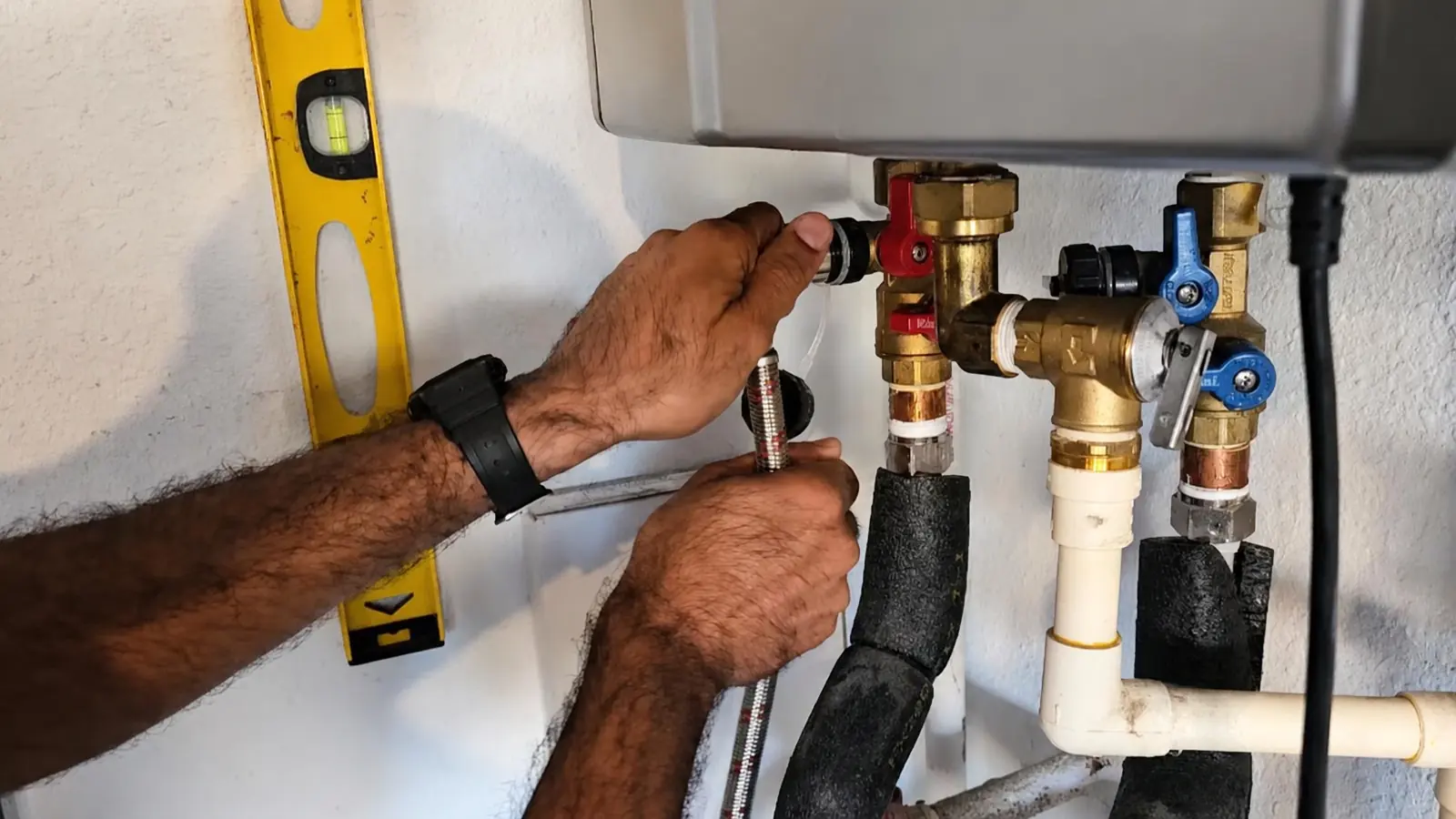
We connect a pump and hoses to the service valves, circulate the solution for the time the manufacturer asks for, rinse the unit and clean the inlet filter. If your home has a private well, tell us, because well water often carries more sediment than public supply.
What to do when a tankless heater shows warning signs
Tankless units tend to tell you what is wrong before they fail outright. Watch for these.
If the unit shuts down, check the display for a code, make sure the gas valve and the power are on and reset it once. If you smell gas, leave the building and call the gas utility or 911 before you call us.
Lukewarm or swinging temperature
Scale or a partly blocked filter is limiting flow through the heat exchanger.
Error codes on the display
Codes point to ignition, venting, flow or temperature faults that need a technician.
Longer wait for hot water
The unit may be cycling off at low flow, or the line to the fixture is long.
Noise or clicking
Ignition trouble, a failing fan or mineral buildup are common causes.
Tankless unit acting up?
Call and tell us the error code on the display. It helps us bring the right part.
Sizing a tankless heater to your home
The question is not how big the tank is, it is how much water you run at once and how cold the incoming water is. In a cold climate like northeastern Connecticut, winter groundwater is much colder than summer, so a unit that is fine in July can struggle in January.
We add up the fixtures that might run together, such as a shower and a dishwasher, and match that flow to a unit that can raise the temperature enough in winter. Two undersized units are not a fix for one oversized family.
| Factor | Why it matters | What we check |
|---|---|---|
| Simultaneous fixtures | More taps at once means more flow needed | Showers, kitchen, laundry. |
| Winter incoming water temperature | Colder water needs more heating capacity | Seasonal low, not the average. |
| Gas line size or electrical capacity | The unit cannot fire without enough fuel or power | Existing line and panel. |
| Venting path | Wrong venting is a safety issue | Length, termination, clearances. |
Replacing a tank with a tankless unit
Swapping a tank for tankless is more than a swap. Gas models often need a larger gas line and special venting that can be run through a wall. Electric models need a lot of power and sometimes a panel upgrade.
We review the existing setup first and tell you honestly if a tankless unit is not a good fit. If a standard tank makes more sense, our installation service handles that instead.
Tankless units are installed to the manufacturer instructions and to the 2021 International Plumbing Code (IPC) that Connecticut adopts. Following both matters, because venting and gas sizing mistakes are safety problems and can void a warranty.
What affects tankless water heater pricing
Prices vary more for tankless units than for tanks, so we quote after we see your setup.
Tankless heaters in eastern Connecticut homes
Newer homes in North Windham and in Mansfield near the university area are the most common tankless installs we see. Older Willimantic houses with small gas lines often need extra work first, and we tell you that up front.
If your home is on a private well, the sediment filter on the heater needs more attention. We note it on the visit so the next flush is on your calendar.
Tankless water heater questions
How often should a tankless water heater be flushed?
Once a year is a common baseline, and homes on well water or with heavy scale may need it more often. We tell you what your unit needs on the first visit.
Is tankless worth it in northeastern Connecticut?
It can be, but winter incoming water is cold, so the unit has to be sized for that. A properly sized unit saves floor space and avoids standby loss. An undersized one will disappoint.
What does a tankless error code mean?
Codes vary by brand, but most point to ignition, flow, venting or temperature faults. Tell us the code when you call and we can often narrow the cause before arriving.
Can I install a tankless heater where my tank was?
Sometimes. The space, gas line, venting and drain have to work. We look at the location first and let you know what has to change.
Do tankless heaters need a permit?
Many towns require permits for new gas or electrical work. We ask for your address and tell you what applies before the job.
How long does a tankless heater last?
Well-maintained units often outlast tanks, but flushing and water quality make a big difference. We do not promise a number because it varies by unit and household.
Keep your tankless heater running right
Call to schedule a flush, a repair or an installation visit.
Call (860) 397-8103