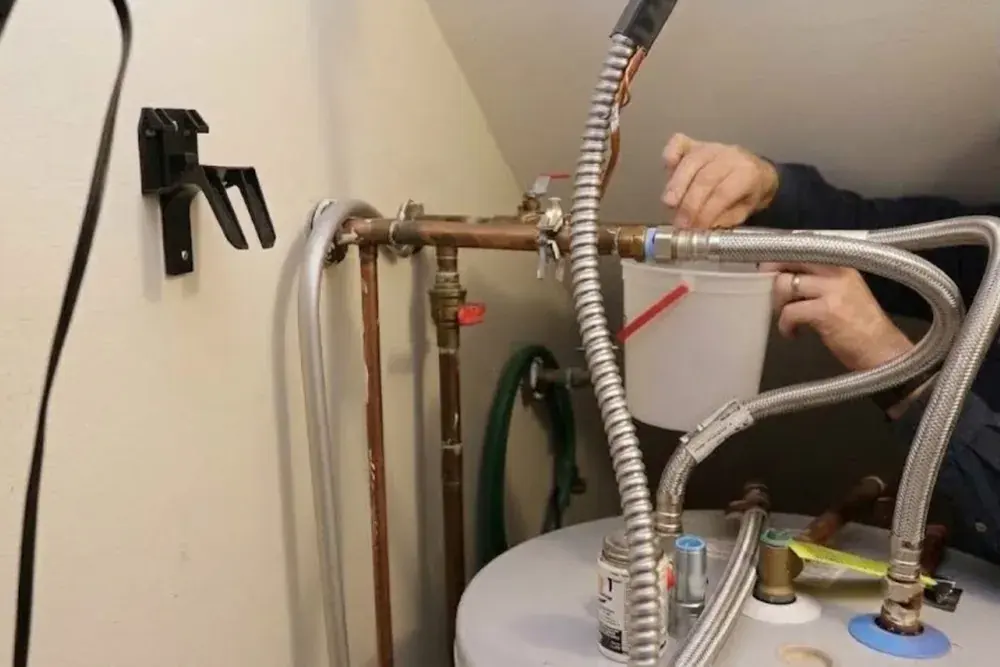
How an electric water heater heats
Most electric tanks have two heating elements, one near the top and one near the bottom, each controlled by its own thermostat. The upper element heats first and the lower one tops off the rest. If one fails, you get less hot water or water that never gets very hot.
A failed upper element often means almost no hot water. A failed lower element means you run out quickly. Knowing which fails helps point to the part.
Symptoms of a failed element
The signs depend on which element failed.
Water is only lukewarm
The upper element or thermostat is failing.
Hot water runs out quickly
The lower element has failed and only the top of the tank heats.
Breaker keeps tripping
An element has shorted to ground.
No hot water at all
The upper element, the thermostat or the high-limit switch has failed.
Test before you replace
Turn off the breaker for the heater at the panel and confirm the power is off with a voltage tester. Remove the access panel and insulation. Use a multimeter to test each element for resistance with the wires disconnected. A good element shows a reading, and one with no reading is open and has failed.
Also test the thermostat and the high-limit reset. A tripped high-limit button is a cheap fix that mimics a failed element. Do not guess at this stage.
| Reading | What it means |
|---|---|
| A steady resistance reading | Element is working. |
| No reading or infinite | Element is open and failed. |
| Reading from element to the tank | Element has shorted to ground. |
| No power at the thermostat | Check the breaker, reset and wiring. |
Code items that matter when you open a heater
The 2022 Connecticut State Building Code adopts the 2021 International Plumbing Code (IPC), which requires a temperature and pressure relief valve with a proper discharge on a tank water heater. When you are working on a heater, check that this valve and its pipe are in place.
If anything looks wrong, our water heater replacement service can fix it or swap the tank.
Not sure what you measured?
Call and we will test the heater and tell you what failed.
The replacement steps
With the power off at the breaker, shut the cold-water valve and drain the tank below the element level through the drain valve. Open a hot tap to let air in. Disconnect the wires, unscrew the element with an element wrench and remove it.
Fit a new gasket and the new element with the same wattage and voltage, tighten snugly and reconnect the wires. Fill the tank fully with the hot tap open until water runs steadily, and only then restore power. An element powered without water burns out in seconds.
Mistakes that cost you a second element
The costly mistake is switching the power on before the tank is full. Another is using an element of the wrong wattage. The label on the tank and the old element give the correct numbers, and the part should match.
Heavy sediment can also coat a new element and shorten its life. If the tank is old and scaled, a replacement tank may be more sensible than another element. Our water heater repair page explains how we decide.
Thermostat settings and scald safety
While the access panel is open, check the thermostat settings. Many manufacturers suggest a setting around 120 degrees Fahrenheit for household use, which reduces scald risk and slows mineral buildup. Both thermostats should be set to the same temperature.
If one is set much higher than the other, the heater may behave oddly. Replace the insulation and the access cover when you are done, and keep the area clear.
Parts and tools you will want on hand
You need a multimeter, a screwdriver, an element wrench, a hose for draining and a voltage tester. The new element must match the voltage and wattage printed on the old one or on the tank label, and it should use the same style of mounting.
Buy the gasket kit that comes with the element. Reusing an old gasket is a common reason for slow leaks after a repair.
When to call a plumber
Call if you are not comfortable working near live circuits, if the tank leaks or if the element will not unscrew. Call if the heater is old and corroded. In that case, replacing the whole tank may be the better route.
We repair electric heaters in Windham and Lebanon. Tell us the brand and the symptoms when you call.
Windham water heater element questions
How do I know if my element or my thermostat is bad?
Test both with a multimeter. A good element reads a resistance, and a thermostat should pass power when it is calling for heat.
Can I replace one element or should I do both?
Often both are worth replacing if the heater is old, but test first. A working element does not need to be swapped.
Is it safe to do this myself?
Only if you turn off power at the breaker, confirm it is off and fill the tank before restoring power. If any of that is unfamiliar, call a plumber or electrician.
Why does my breaker keep tripping?
A shorted element is a common cause. Disconnect and test it before turning the breaker on again.
Is the heater worth repairing?
If the tank is leaking or badly scaled, replace it. If it is sound, an element swap is cost-effective.
Not comfortable doing it yourself?
Call and we will test the heater and replace what failed.
Call (860) 397-8103