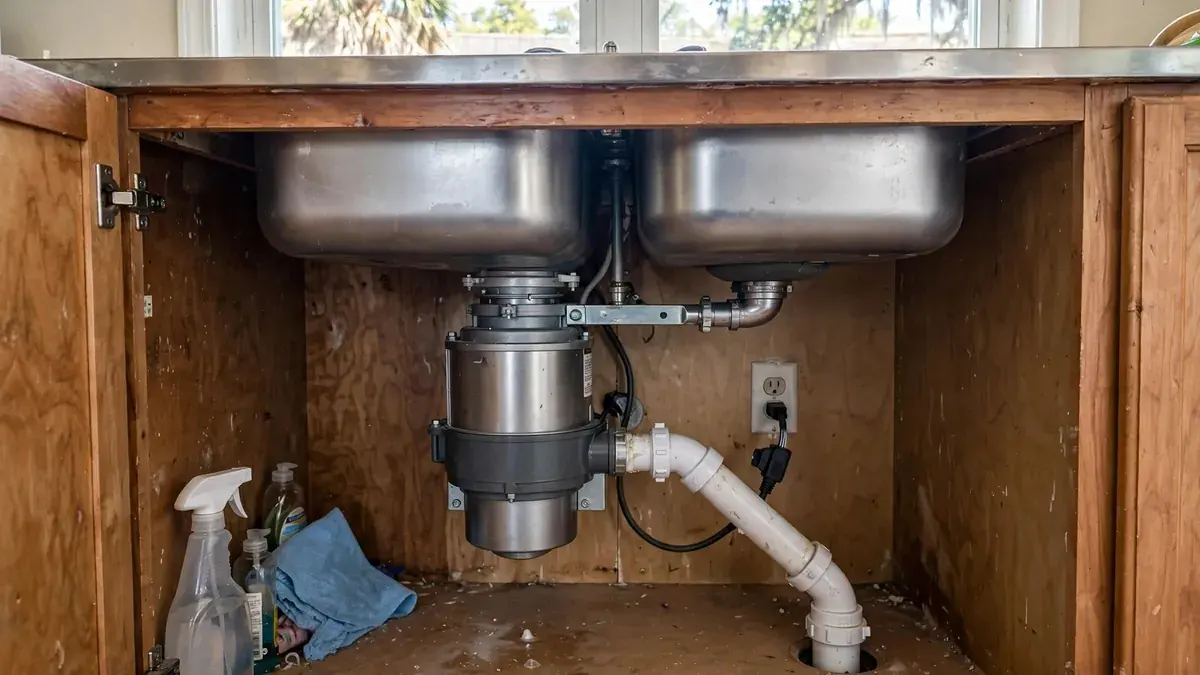
What a single sink installation involves
A disposal replaces the basket strainer in the sink drain. It mounts under the sink, grinds food and sends it down the drain. A single-bowl sink has one drain, so there is one connection to make.
The job has three parts: mounting the unit, connecting the drain and powering it. Each has details that decide whether it works well and lasts.
Before you buy: sizing and fit
Check the space under the sink. Larger units are taller and may not clear the pipes or a shelf. Consider the motor size, which affects how well the unit handles hard food, and whether the unit has a quiet insulation.
Check that your sink has a standard 3.5 inch opening. Most kitchen sinks do. Look at the existing drain and the trap, because the new unit changes where the drain pipe attaches.
| Feature | Why it matters |
|---|---|
| Motor size | More power handles tougher food and jams less. |
| Mounting system | Quick-lock mounts are easier to install and remove. |
| Height under the sink | Larger units may not fit with the trap. |
| Continuous or batch feed | Batch feed needs the lid in place to run. |
Code and power for a disposal
The 2022 Connecticut State Building Code, effective October 1, 2022, adopts the 2021 International Plumbing Code (IPC) and the 2020 National Electrical Code (NEC). The plumbing code sets trap and drain requirements, and the electrical code covers the power supply to the unit.
If there is no outlet under the sink, wiring is needed, and that may call for an electrician. Our plumbing installation service covers the water and drain side.
Mounting the unit
Remove the old strainer and clean the sink opening. Apply plumber's putty under the new sink flange, press it into the opening and attach the mounting ring from below. Tighten the screws evenly so the flange sits flat.
Hang the disposal on the mounting ring and twist to lock it in place. Do not tighten fully until the discharge elbow lines up with the drain.
Want it done without the hassle?
Call and we will handle the mount, the drain and the power.
The drain connection
The disposal discharges through an elbow into the trap. If you have a dishwasher, its drain hose connects to a nipple on the disposal. Knock out the plug inside that nipple before you connect the hose, or the dishwasher will not drain.
Connect the discharge to the trap, check the slope and test with water. A drain pipe that slopes the wrong way holds water and smells. Our drain cleaning page explains what to do if the line behind the disposal is slow.
Power and the switch
Most disposals use a cord plugged into an outlet under the sink, or they are hardwired to a switch. If there is no outlet or switch, an electrician should add one. Water and electricity need care.
Never run the unit before the water is connected and tested. Run cold water and turn the unit on to check for leaks and noise.
First run and what to grind
Run cold water first, switch on the unit and feed in a few small pieces of soft food. Listen for rattling, and check under the sink for leaks while it runs. Cold water keeps fats solid so they are chopped and flushed rather than smeared.
Avoid bones, fruit pits, grease, fibrous vegetables, coffee grounds in bulk and starchy foods that swell. Run water for several seconds after the grinding stops to clear the line.
When the sink or the old drain is in the way
Some sinks are thin stainless steel with a flange that does not match a standard mount. Others have an old strainer that is corroded into place. Cutting it out damages the sink, so we check before we start.
If the existing drain is galvanized or the trap is old, replace those parts while the sink is empty. Reconnecting a new disposal to a worn trap is a common reason for leaks a week later.
Removing an old disposal
Turn off power at the breaker before you touch the unit. Disconnect the drain pipe and the dishwasher hose, then twist the unit off its mounting ring. Support it, because it is heavy.
Check the sink flange and mounting hardware for wear before installing the new unit. If the old unit was leaking, check the cabinet floor for damage.
Mistakes to avoid
The most common mistakes are forgetting to knock out the dishwasher plug, overtightening the flange and not using putty or a gasket. Another is failing to check the slope of the drain.
If you are in Coventry or Mansfield and want it done properly, we install and test disposals. Tell us the sink and the model.
Windham garbage disposal installation questions
Can I install a disposal on any sink?
Most standard kitchen sinks work. Some stone or thin sinks need special mounting.
Do I need an electrician?
If there is no outlet or switch under the sink, yes. We can do the plumbing and tell you what the electrical work needs.
Why is my dishwasher not draining after installing the disposal?
The knockout plug in the dishwasher nipple was probably not removed.
Can a disposal be installed on a septic system?
Yes, but heavy use adds solids to the tank. Check with your septic service on pumping frequency.
How long does installation take?
A straightforward swap is often an hour or two.
Want it installed properly?
Call and we will handle the mount, the drain and the power connection.
Call (860) 397-8103